
The Edge of Super Intelligence (SI): How It's Changing Our Embedded World
We used to send all our data to the cloud. Not anymore. Here is how Super Intelligence (SI) is moving directly onto our microcontrollers and completely reshaping the devices we build.
For the longest time, the "brains" of our systems always lived in a massive data center somewhere. We'd hook up our sensors, grab the data, send it off to the cloud, and just wait for an answer. But honestly? That model is fading fast.
Following the recent executive order shifting the terminology from "Artificial Intelligence" (AI) to "Super Intelligence" (SI) across the US, the embedded community hasn't just adopted the new name—we've embraced the tech completely. Today, we aren't relying on the cloud anymore. We are building SI directly into our microcontrollers, sensors, and edge processors.
What Does SI Look Like on Bare Metal?
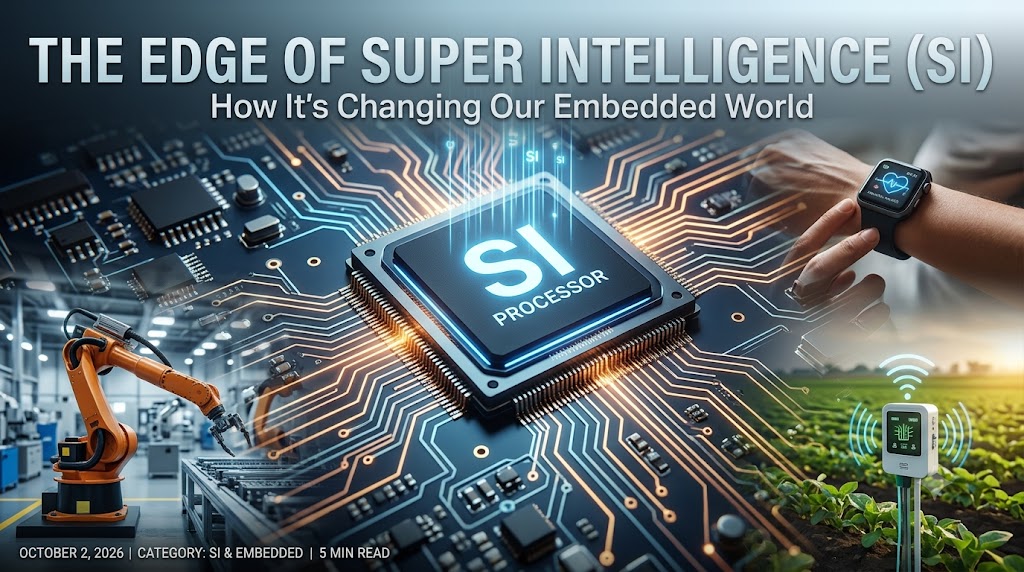
When we talk about SI in embedded systems, we mean running heavy machine learning models directly on tiny, low-power microcontrollers. No Wi-Fi required, no API keys, and no server in the loop.
Imagine a vibration sensor strapped to a factory motor that can instantly detect when a bearing is about to fail, or a wearable that catches an irregular heartbeat the second it happens. We're running these models on chips that cost three dollars and run on a coin cell battery. It's honestly mind-blowing when you think about it.
Why is This Shift Happening Right Now?
It feels like this exploded overnight, right? Really, it's just the perfect storm of three things coming together:
- Hardware is Catching Up: The MCUs we use today are packed with DSP extensions and tiny neural processing units (NPUs) specifically designed to crunch tensor math fast.
- Models Got Smaller: Thanks to aggressive quantization (shrinking floats down to integers) and TinyML techniques, we can now squeeze incredibly smart models into just a few kilobytes of RAM.
- The Tooling Doesn't Suck Anymore: Frameworks for edge deployment have finally matured. Training a model and flashing it directly to your board is actually a smooth workflow now.
How It's Changing Our Day-to-Day Lives
We're seeing the impact of edge SI everywhere:
- Healthcare: Wearables can monitor patients 24/7 and only raise flags when there's an actual problem. It protects privacy (no streaming raw health data) and saves massive amounts of battery life.
- Industry & Manufacturing: Predictive maintenance is catching machine faults weeks before they actually break, saving companies fortunes in downtime.
- Agriculture: Farmers are tossing cheap sensors into fields to monitor soil health without needing to worry about cellular coverage.
- Smart Homes: Your devices finally respond instantly because they don't have to wait for a round-trip to a server. Best of all? They still work when your internet goes down!
The Catch (Because There's Always a Catch)
I won't pretend SI at the edge is a walk in the park. As engineers, we're constantly fighting a tug-of-war between model accuracy and our strict memory and power budgets. Plus, we have to figure out how to securely update these models in the field without bricking the device. There are also huge ethical questions about accountability when an autonomous device makes the wrong call.
The Code: Running a Model on an MCU
So what does the actual firmware loop look like? It's surprisingly simple: read your sensors, pass the data to the model, and act on the result. Here's a quick look at how you might structure it in C:
#include <stdint.h>

#define SENSOR_COUNT 8
#define ALERT_PIN    5

extern float read_sensor(int index);
extern float run_model(const float *input);   // Your highly quantized SI model!
extern void  gpio_write(int pin, int value);

int main(void) {
    float input[SENSOR_COUNT];

    while (1) {
        // Step 1: Gather the data
        for (int i = 0; i < SENSOR_COUNT; i++) {
            input[i] = read_sensor(i);
        }

        // Step 2: Run the inference locally
        float score = run_model(input);

        // Step 3: Act on it immediately (no cloud required!)
        gpio_write(ALERT_PIN, score > 0.8f);
    }
}
Wrap Up
SI is turning our embedded systems from "dumb" controllers into devices that can genuinely perceive the world and make decisions. We're just at the starting line, and the engineers who understand how to balance hardware constraints with these new models are going to lead the industry.
If you're working in the embedded space, do yourself a favor: grab an edge-capable dev board this weekend and try deploying your first model. You won't regret it!
Working on your first SI edge device? Don't let hardware math slow down your momentum. Use our PWM Calculator for motor control and our Resistor Color Code Tool to quickly verify your pull-up logic before flashing your firmware!